Most businesses don't need disrupting. They need retrofitting.
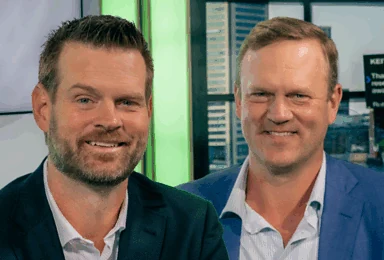
Andy and Landon Swan have founded three companies from nothing. Now they work inside established businesses — learning how yours actually runs, putting AI where it takes real cost out, and building revenue lines on what you already own. You end up with a company that costs 20–50% less to run and sells things it couldn't sell before.
Type in your numbers, pick an outcome, and run it. Total expenses and profit calculate themselves.
The Retrofit ModelYour statement, before and after
Your numbers today
Total expenses$12,750,00085% of revenue
Profit today$2,250,00015% margin
Total expenses and profit are calculated from what you enter. You can type shorthand — 15m, 750k.
After the retrofit
RevenueToday $15MAfter $15M
New lines built on what you already own: run the estimate to see it
ExpensesToday $12.8MAfter $12.8M
Hover any block to see what sits in it.
ProfitToday $2.3MAfter $2.3M
Margin 15% → 15%
Revenue todayNew revenue & profitMaterialsFixed overheadBlue collarWhite collarOutside servicesTech, data & process
Expenses run left to right from the lines AI barely touches to the ones it reshapes hardest. Hover any block for the detail.
What each outcome assumes
Line
Conservative
Average
Optimistic
Revenue
+50%
+125%
+200%
Materials & direct costsScales with revenue
+50%
+125%
+200%
Fixed overheadHolds flat
No change
No change
No change
Blue collar payrollScales with revenue
+50%
+125%
+200%
White collar payroll
−20%
−40%
−60%
Outside services & vendors
−35%
−60%
−85%
Tech, data & process
−20%
−48%
−75%
Profit is calculated, not assumed: revenue after, minus every expense line after it moves. These are outcomes we target across a full engagement, not a guarantee — the first conversation is where we find out which column your business lands in.
The part nobody says out loud
“AI is coming for your industry. Either you harness it and dominate, or you lose to whoever does.”
This isn't a ten-year problem. Somewhere in your market there's a competitor with a fraction of your history and a fraction of your headcount, quoting faster than you, answering customers at midnight, and undercutting you on price without giving up margin.
The advantage doesn't go to the biggest company, or the oldest one. It goes to whoever puts AI to work first.
You're holding what they'd kill for: customers, cash flow, reputation, and decades of knowing how the work is really done. That's the part that can't be built quickly. The rest of it can, and that's the part we do.
Two levers, pulled together
Efficiency pays for the build. The build is where the money is.
Cost cutting with AI is fast and impactful. We take the waste out of the work nobody enjoys doing, then spend that freed-up capacity on products and lines your competitors can't answer.
Illustrative. Cutting alone flattens by the end of year one. The build keeps compounding.
Lever 01 — Cut
Take the drag out of the work
AI can either replace inefficient workers, or make efficient workers 5x as powerful. Which one depends on the employee and your philosophy.
Quoting, estimating and proposal generation
Order entry, invoicing and collections follow-up
Tier-one customer support and inbound triage
Scheduling, dispatch and route planning
Marketing production and content churn
Reporting nobody has time to read
Lever 02 — Create
Sell what you're already sitting on
AI allows you to build custom solutions to your problems, and custom solutions to your optimistic goals.
Quote faster
Offer more
Deliver more
Expand your product line
Consistently “wow” your customers
Sell and service with a unique combination of unmatched experience and unlimited time and care
Three ways in
We can teach your team, build it for you, or both.
“We're operators, not a slide-deck vendor. Every engagement ends with something running in production — and someone on your payroll who understands it.”
Teach
We train your people
Hands-on work with the team that actually does the job — your estimators, your CSRs, your marketers — until AI is part of how they work, not a tool they forgot they had.
Best when you have talent and no time
Build
We build the system
We design, ship and run it. Real software against your real data, integrated with the tools you already pay for. You get the code and the keys.
Best when the fix is a product, not a habit
Both
We build & hand it over
The usual answer. We build the first systems, your team ships the next ones with us alongside, and we leave when you stop needing us.
Best when you want this to outlast the engagement
We learn the business before we change anything.
A typical first engagement. Yours moves faster or slower depending on how much of your business still lives on paper.
01
Immersion
Week 1
We learn how your company actually works — not the org chart version. Ride-alongs, time with the people doing the job, an honest read of the P&L. No recommendations this week. Just understanding what you've built and where it strains.
02
Fresh eyes
Week 2
We map every recurring task and every unsold asset against what AI can genuinely do today, ranked in dollars.
03
First win
Weeks 3–6
We take the single highest-value item off that list and rebuild it end to end. One process, live in production, with a measured before and after.
04
Rollout
Weeks 7–12
The rest of the efficiency work goes in, one system at a time, each adopted before the next starts. Your team is in the room for all of it. This is where the 20–50% shows up on a real statement.
05
Expand
Quarter 2 onward
Now we spend the capacity we freed. New products, new segments, new pricing — built on the data and the margin the first four phases handed you. This is the phase that changes what the business is worth.
Who you'll actually be working with
Two founders, five people, no layers.
Andy and Landon lead every engagement themselves, backed by a three-person build team. Five of us do what a firm ten times the size would quote you for — because we run SwanLabs on exactly the systems we install for you. You'll see the proof before you sign anything.
Let's win together.Andy & Landon Swan · Louisville, KY
Andy Swan
Co-founder
Serial founder and investor. Built and sold a trade sharing platform, then spent a decade turning consumer behavior into investable signal at LikeFolio. He works on the question most owners avoid: what is this business actually worth to whoever buys it, and what would make that number bigger?
Landon Swan
Co-founder
Solutions and detail oriented. Obsessed with finding an edge that can be leveraged. He digs until he completely understands, then flips the problem around and exposes a simple powerful solution. Loves to ask “What if this could be automated?”
Behind us: a three-person team covering engineering, data and delivery — the same people on your account from week one to handoff. No associates, no bench, nobody learning your industry on your dime.
Tell us what your business does. We'll tell you what we'd retrofit first.
One call, forty-five minutes, no deck. Bring your revenue, your headcount and the process that annoys you most. You'll leave with a specific answer whether or not we work together.